What Are Fully Serviced Offices?
Fully serviced offices are ready-to-use private offices that are furnished, connected and managed by a workspace operator. Instead of leasing an empty office and arranging the furniture, internet, utilities, cleaning and day-to-day facilities management separately, a business pays a monthly fee for an operational workspace.
Serviced offices are commonly available on more flexible agreements than conventional commercial leases and can accommodate anything from an individual or small team to larger businesses requiring private office suites.
The main attraction is simplicity. A business can secure an office, connect its computers and start operating without first completing a lengthy office fit-out or setting up multiple service contracts.
However, a serviced office is not automatically the right solution for every business. Understanding what is included, how pricing works and how serviced offices compare with traditional office leases is important before deciding which workspace model suits your company.
How Does a Fully Serviced Office Work?
A serviced office operator leases or manages office space within a commercial building and divides the space into private offices, meeting rooms and shared facilities. Businesses then occupy these offices under flexible agreements, usually based on the number of workstations or the size of the private office required. Instead of dealing directly with separate internet providers, cleaning companies, furniture suppliers and other contractors, these services are managed by the workspace operator. A typical serviced office agreement may therefore combine the office itself with furniture, internet, electricity, cleaning, reception services and access to common facilities. The exact services differ between operators, so businesses should always check what is included before comparing prices.
What Is Included in a Serviced Office?
The main difference between a serviced office and a conventional office lease is that much of the infrastructure required to operate the office is already provided.
A typical serviced office may include:
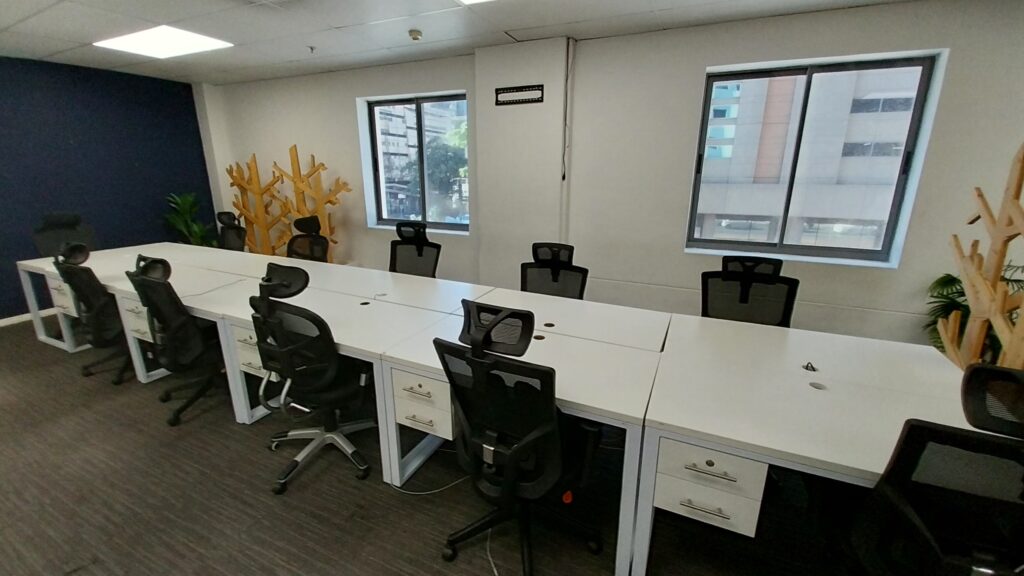
- Desks, chairs and office furniture
- High-speed internet
- Electricity and water
- Cleaning of offices and common areas
- Reception services
- Access control and security
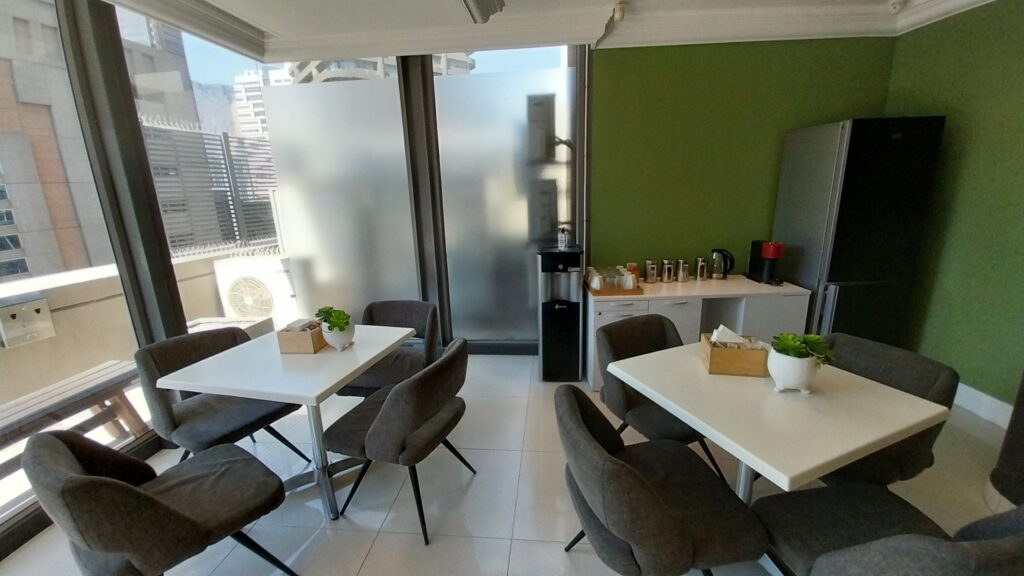
- Shared kitchens
- Breakaway areas and lounges
- Meeting and boardrooms
- Mail and courier handling
- Air conditioning
- Building maintenance
- Printing and copying facilities
- Tea and coffee facilities
- Backup power where provided by the building or operator
Some operators include most of these services within the monthly fee, while others charge separately for meeting rooms, printing, parking, additional internet capacity, telephone services or refreshments. For this reason, the advertised monthly cost should not be the only figure considered when comparing serviced offices.
Are Serviced Offices Fully Furnished?
Yes, most fully serviced offices are furnished and ready for occupation. A typical private office will already contain desks, office chairs and basic storage. Shared meeting rooms, kitchens, reception areas and lounges are also normally furnished by the operator. This allows businesses to move into an office without buying furniture or arranging an office fit-out.
Larger private office suites may also allow a degree of customisation. Depending on the operator and length of the agreement, businesses may be able to change layouts, add meeting rooms or introduce elements of their own branding. Businesses requiring substantial control over their office design and corporate identity may, however, find a conventional or managed office more suitable.
How Long Can You Rent a Serviced Office For?
One of the main advantages of serviced offices is flexibility. Conventional commercial office leases in South Africa commonly involve commitments of several years. Serviced office agreements can generally accommodate shorter periods.
The actual minimum term depends on the operator and the particular office. Businesses may be able to secure offices for a few months, 12 months or longer. Longer commitments may also attract more favourable commercial terms.
This flexibility can be particularly useful when a company does not yet know exactly how much office space it will require in two or three years.
Who Uses Fully Serviced Offices?
Serviced offices are no longer used only by startups and individual entrepreneurs.
They can suit several different types of businesses.
Startups and Growing Companies
A growing business may not want to invest significant capital in fitting out an office while its staff complement is still changing. A serviced office allows the business to establish a professional workspace and increase its office requirement as the team grows.
Businesses Entering a New Market
A Johannesburg or international company establishing a Cape Town operation may initially have only a small local team. Taking a serviced office provides an immediate base while the business determines its longer-term staffing and property requirements.
Project Teams
Established businesses sometimes need additional accommodation for a particular contract or project. Rather than expanding their permanent office, a project team can occupy serviced space for the required period.
Businesses Between Offices
Serviced offices can provide temporary accommodation while a new conventional office is being fitted out, refurbished or prepared for occupation.
Hybrid Businesses
Companies operating hybrid working models may require fewer permanent desks but still need meeting rooms, collaboration space and a professional office environment.
Larger Corporate Teams
Larger serviced office centres increasingly provide private suites capable of accommodating substantial teams. These can be useful for regional offices, project teams, support operations and companies requiring flexibility before making a longer-term property commitment.
What Is the Difference Between a Serviced Office and Coworking?
The terms are often used interchangeably, but they describe different types of workspace. A serviced office generally provides a company with its own secure private office while shared facilities such as kitchens, reception areas and meeting rooms are managed by the operator.
A coworking space generally involves individuals or small teams working within a shared open workspace. Users may have a dedicated desk or use any available hot desk.
Many flexible workspace centres offer both.
For example, the same location may provide:
- Hot desks
- Dedicated desks
- Private serviced offices
- Meeting rooms
- Larger enterprise suites
A company requiring privacy for staff, confidential discussions or client meetings will generally prefer a private serviced office rather than an open coworking environment.
What Is the Difference Between a Serviced Office and a Managed Office?
Managed offices generally sit between serviced offices and conventional leasing. A serviced office usually forms part of a larger flexible workspace centre. The tenant has a private office but shares facilities such as reception, kitchens, lounges and meeting rooms with other businesses. A managed office is normally a larger, self-contained workspace created for one company. It may include a private kitchen, boardrooms, meeting rooms, branding and dedicated breakaway areas.
Furniture, internet, utilities, cleaning and facilities management can still be incorporated into one monthly agreement. Managed offices are therefore particularly relevant to larger businesses that want the convenience of a serviced solution but require more control and privacy.
Serviced Offices vs Traditional Office Leases
The best choice depends on the size of the business, anticipated period of occupation and level of control required over the workspace. With a conventional office lease, a tenant normally leases a defined area directly from the landlord. Depending on the premises, the business may then need to arrange its own:
- Office fit-out
- Furniture
- Internet installation
- IT infrastructure
- Cleaning
- Utilities
- Access-control requirements
- Meeting rooms
- Kitchen facilities
- Maintenance contracts
A longer lease can make sense when a company has a stable headcount and intends to occupy the same premises for several years. It also gives the tenant considerably more control over its office layout, branding and fit-out. A serviced office shifts much of this responsibility to the operator. This reduces the work required before occupation but generally comes at a higher rate per workstation or square metre.
The correct comparison is therefore not simply:
serviced-office rental versus conventional-office rental. Businesses should compare the total cost of occupation.
Are Serviced Offices More Expensive?
On a straight rental-per-square-metre comparison, serviced offices can be more expensive than conventional office space. That does not necessarily mean the overall cost is higher. A conventional office can involve substantial additional expenditure on fit-out, furniture, internet infrastructure, utilities, cleaning and other operational requirements. There may also be several months between signing a lease and being ready to occupy the premises.
A serviced-office fee incorporates many of these expenses into a single monthly payment. For a business occupying space for a relatively short period, or one that wants to avoid significant upfront expenditure, the total cost may therefore compare favourably. For a larger company planning to remain in the same office for five or more years, a conventional lease may provide better long-term value.
The calculation needs to be made around the specific requirement rather than assuming either option is always cheaper.
What Are the Main Benefits of Fully Serviced Offices?
Faster Occupation
Most serviced offices are ready for immediate or near-immediate occupation. Furniture, internet and basic office infrastructure are already installed.
Lower Initial Capital Requirement
Businesses generally avoid the major upfront cost associated with fitting and furnishing a conventional office.
Flexible Terms
Shorter commitments reduce the risk of taking too much or too little space when staff numbers may change.
Ability to Scale
A company may be able to move into a larger or smaller private office within the same serviced-office centre as its requirements change.
One Monthly Payment
Combining multiple office costs into one account simplifies budgeting and reduces the number of suppliers a business needs to manage.
Shared Facilities
Meeting rooms, lounges and other facilities can be shared rather than incorporated into every private office.
This can help businesses occupy less dedicated floor area.
Established Business Locations
Many serviced-office centres operate from established commercial buildings in locations such as the Cape Town CBD, Foreshore, V&A Waterfront, Century City and Claremont.
What Are the Disadvantages of Serviced Offices?
Flexibility comes with trade-offs. Serviced offices generally offer less control over the design and operation of the workplace than a conventional office. Businesses should consider:
Higher Cost Per Desk
The operator is providing furniture, services, facilities and flexibility, which are incorporated into the monthly charge.
Limited Branding
Smaller private offices may provide limited opportunities for reception branding, signage or a completely customised corporate environment.
Shared Facilities
Boardrooms, kitchens and lounges may be shared with other businesses.
Meeting-Room Charges
Meeting-room use is not always unlimited. Some packages provide a monthly allocation and charge for additional hours.
Less Control Over Infrastructure
Internet, furniture and common facilities are normally selected and controlled by the operator. For some businesses, these limitations are insignificant. For others, particularly larger companies with specialised operational requirements, they can influence the decision between serviced and conventional space.
How Should You Compare Serviced Office Prices?
Do not compare options using only the advertised desk rate. Ask each provider for a breakdown of what the monthly fee includes.
Important questions include:
- Is internet included?
- Is electricity included?
- Is backup power included or charged separately?
- How many meeting-room hours are included?
- Is printing included?
- Are tea and coffee included?
- Is cleaning included?
- Is parking available and what does it cost?
- Is there a setup or administration fee?
- Is a deposit required?
- Can additional desks be added?
- What happens if the team needs a larger office?
- What notice period applies?
- Are prices quoted excluding or including VAT?
Comparing the full monthly occupancy cost provides a much more accurate picture than comparing desk prices in isolation.
What Should You Check Before Signing a Serviced Office Agreement?
The flexibility of serviced offices does not mean businesses should skip the normal property assessment. Check the actual private office and not only the shared reception and meeting areas. Consider whether there is enough natural light, privacy, storage and workspace for the team. Test the commute and consider public transport and parking availability. Confirm the internet specification if your business uses cloud applications, video calls or large data transfers. Understand exactly how meeting rooms are booked and whether there are enough rooms available during busy periods. Businesses operating after normal office hours should also confirm 24-hour access and whether air conditioning, security and other building services operate during those hours.
Serviced Offices in Cape Town
Cape Town has an established flexible-office market with serviced workspace available across most of its main commercial nodes.
The Cape Town CBD and Foreshore provide some of the widest choices, ranging from small private suites to larger corporate serviced offices. These locations work well for businesses requiring access to public transport, professional services, the CTICC and central Cape Town.
The V&A Waterfront offers serviced offices within a mixed commercial and hospitality precinct and is commonly considered by businesses looking for a client-facing location.
Century City provides serviced and flexible offices outside the CBD with good access to the N1 and surrounding northern suburbs.
Claremont provides options for businesses wanting to operate in the Southern Suburbs while remaining close to public transport and the M3.
The best location depends on where employees live, client requirements, parking needs and the type of business occupying the space.
When Does a Conventional Office Make More Sense?
Serviced offices solve a particular set of property requirements. They are not a replacement for conventional office leasing in every situation.
A traditional office may be more suitable when a company:
- has a stable staff complement;
- expects to occupy the premises for several years;
- requires extensive corporate branding;
- needs specialised infrastructure;
- wants exclusive meeting rooms and kitchens;
- requires a large self-contained office;
- can justify investing in a customised fit-out.
The longer a business intends to remain in the premises, the more important it becomes to compare a serviced solution with the total long-term cost of leasing and fitting its own office.
When Does a Serviced Office Make More Sense?
A serviced office is worth considering when speed, flexibility and reduced upfront expenditure are more important than having complete control over the workplace. It can be particularly suitable when a company:
- needs to occupy quickly;
- is establishing a new branch;
- has uncertain future staff numbers;
- requires temporary project space;
- does not want to fund an office fit-out;
- needs a smaller private office;
- wants flexible lease terms;
- requires a temporary office while permanent premises are being prepared.
The decision should ultimately be based on the business’s expected period of occupation, staff requirements and total property cost.
Frequently Asked Questions About Fully Serviced Offices
What does fully serviced office mean?
A fully serviced office is a furnished and operational private workspace managed by a serviced-office provider. Services such as internet, utilities, cleaning, reception and shared facilities are generally included within or available through the monthly office package.
Are serviced offices private?
Yes. A serviced office normally gives a business its own lockable private office. Facilities such as reception areas, kitchens, lounges and meeting rooms may be shared with other businesses.
Is internet included in a serviced office?
Internet is normally included, although speeds, dedicated bandwidth and additional IT services vary between operators. Businesses with specific connectivity requirements should confirm the service before signing an agreement.
Is furniture included?
Yes. Fully serviced offices are generally supplied with desks, chairs and basic office furniture, allowing a business to occupy without purchasing its own furniture.
Do serviced offices include meeting rooms?
Most serviced-office centres provide meeting and boardrooms. Some packages include a certain number of meeting-room hours, while additional use may be charged separately.
Do serviced offices include parking?
Parking is normally separate from the serviced-office fee and depends on availability within the building. Businesses should confirm both the parking allocation and monthly cost.
Can a business use a serviced office as its registered address?
Many serviced-office providers allow businesses to use the location as their business address, but this should be confirmed with the individual operator before entering into an agreement.
Can large companies use serviced offices?
Yes. Serviced offices can accommodate larger teams as well as smaller businesses. Some operators provide private enterprise suites or entire sections of a flexible workspace for corporate occupiers.
Finding the Right Serviced Office
Choosing a serviced office should start with the same questions used for any commercial property requirement: how many people need space, where should the office be located, when is occupation required and how long is the business likely to remain there? Once these points are established, businesses can compare serviced-office centres according to total monthly cost, location, private office size, meeting facilities, parking, backup power and flexibility. For companies requiring immediate, furnished and flexible workspace, a serviced office can provide a practical alternative to taking a conventional lease and completing a new office fit-out. Businesses with a more stable long-term requirement should compare both options before committing, as a conventional office may provide greater control and better long-term value.